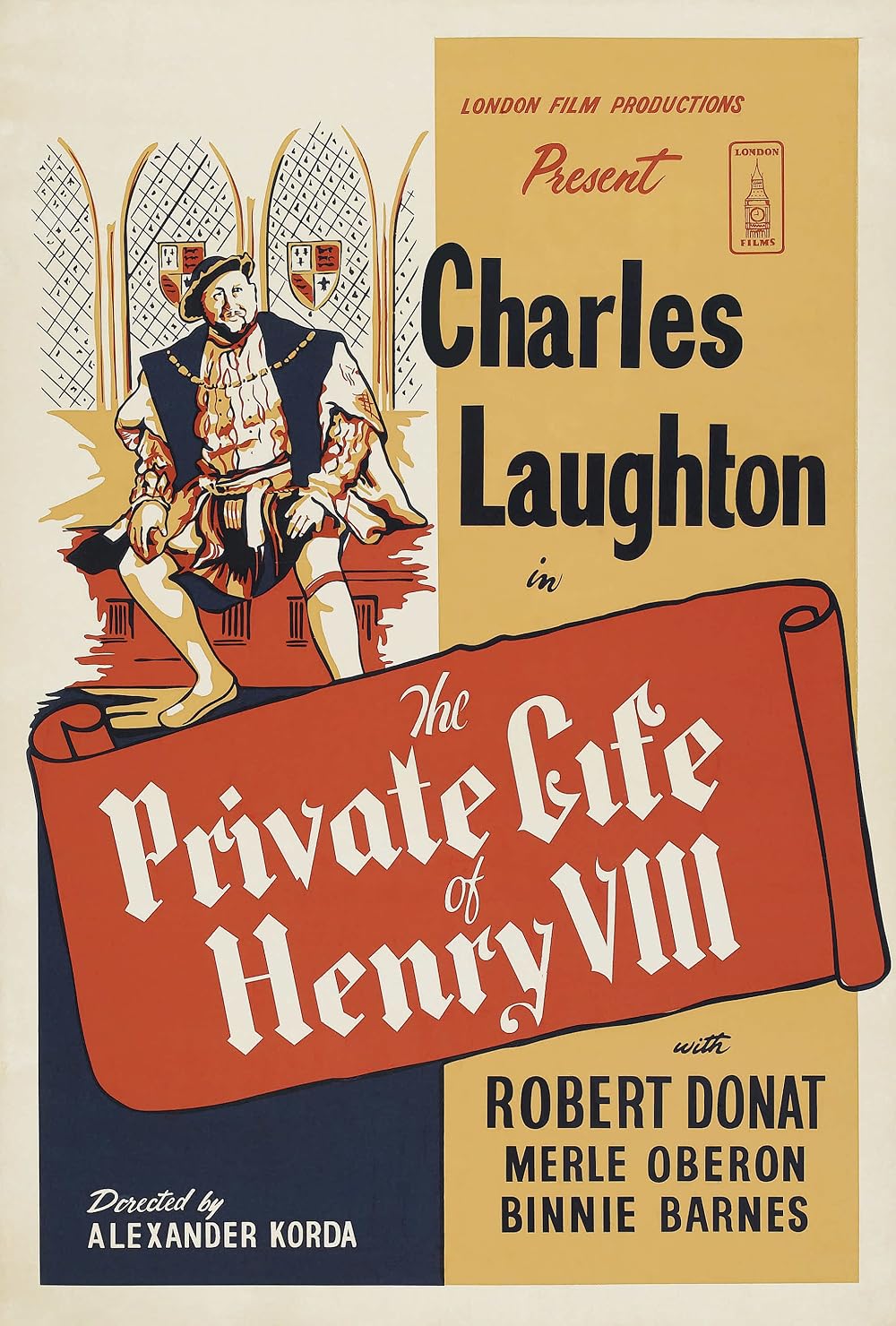
When The Private Life of Henry VIII premiered in 1933, it did more than dramatize Tudor history—it redefined it. Under the direction of Alexander Korda, the film departs from conventional historical spectacle, turning instead toward the domestic sphere. What emerges is not the figure of a distant monarch, but a man entangled in marriage, desire, insecurity, and performance.
Rather than charting political events, the film constructs Henry VIII through his relationships—six marriages that collectively form an emotional and psychological arc. Each queen reflects not only a different stage in his life, but a different mode of attachment: duty, passion, tenderness, illusion, and ultimately, companionship. In doing so, the film reframes history as something deeply subjective—selective, interpretive, and shaped as much by omission as by inclusion.
At the center of this reimagining is Charles Laughton, whose performance remains definitive. Drawing inspiration from Hans Holbein the Younger’s portraiture, Laughton crafts a Henry who is at once imposing and absurd, authoritative yet vulnerable. His king is not merely a ruler, but a spectacle—observed, discussed, and even shaped by those around him. In this sense, monarchy becomes performance, and power becomes inseparable from perception.
The film also operates within a broader cultural context. Produced at a time of mounting political tension in 1930s Europe, it subtly engages with questions of national identity, authority, and leadership. Its emphasis on spectacle, public opinion, and the fragility of power resonates beyond its Tudor setting, suggesting parallels with its own contemporary moment.
Ultimately, The Private Life of Henry VIII is less concerned with historical accuracy than with historical meaning. It invites us to consider not just who Henry was, but how he is remembered—and why.
In this episode, we explore celebrity culture, emotional evolution, and the paradox of power through The Private Life of Henry VIII.
Listen to it here:


Leave a Reply