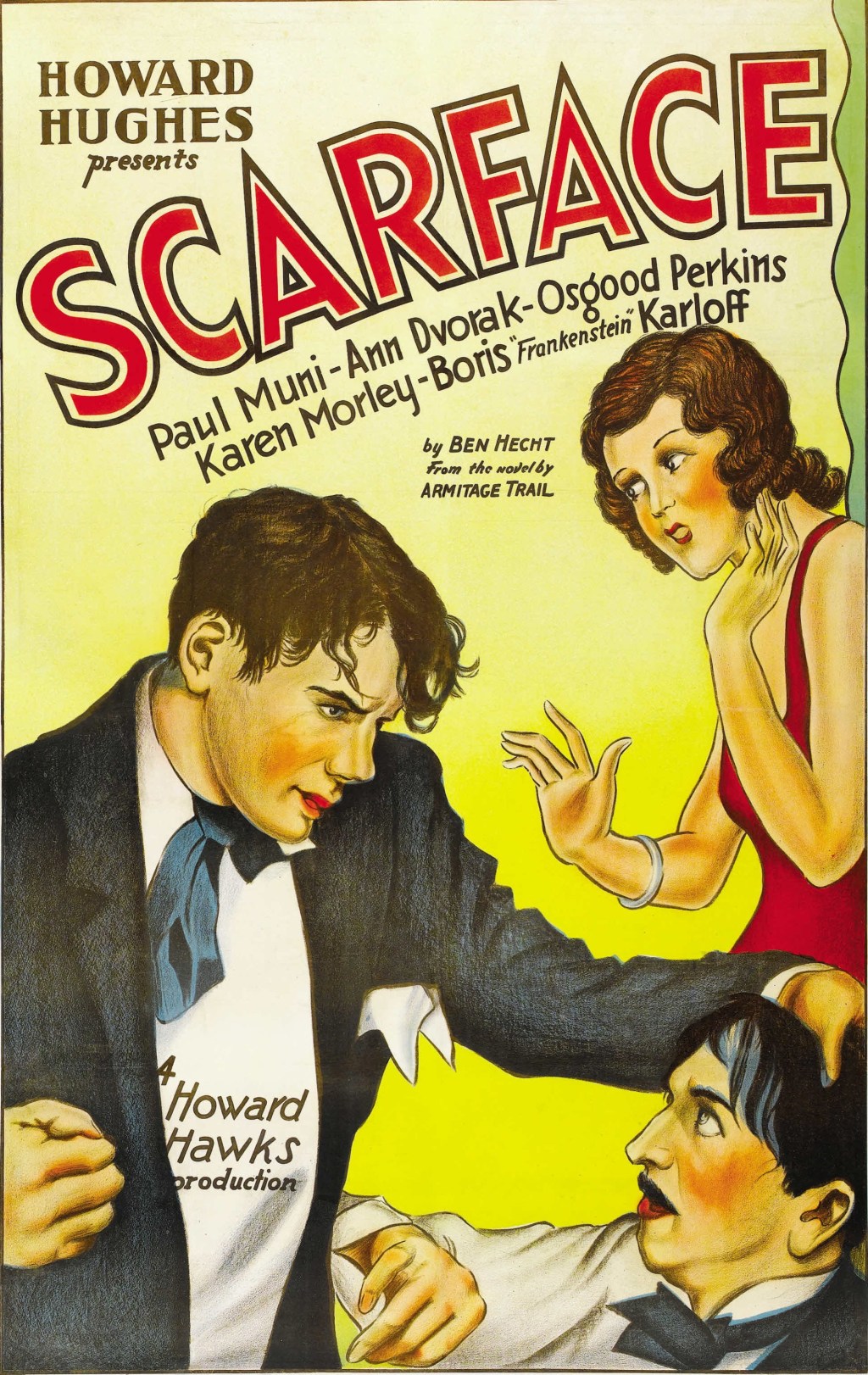
When Scarface premiered in 1932, it was far more than just another gangster picture. Produced by Howard Hughes and directed by Howard Hawks, the film arrived at the height of America’s obsession with Prohibition-era crime — and at the height of Hollywood’s anxiety about its own influence.
Loosely inspired by Al Capone and based on the novel by Armitage Trail, Scarface follows the meteoric rise and spectacular collapse of Tony Camonte, played with unsettling theatricality by Paul Muni. Unlike earlier gangster films, Scarface did not merely suggest brutality — it staged it with operatic boldness. Machine guns, betrayals, ambition, sexual tension, and civic hypocrisy collide in what became one of the most controversial films of its era.
But the real drama unfolded behind the camera.
The film endured a prolonged and bitter struggle with the Hays Office, Hollywood’s censorship authority. Script revisions were demanded. Scenes were cut. A moralizing prologue was imposed. Even alternate endings were created to soften the film’s impact. At one point, its release was stalled for nearly a year. Hughes fought, compromised, resisted, and ultimately maneuvered his way to distribution — proving that controversy could function as early Hollywood marketing.
Scarface also captured something deeper: the contradictions of the American Dream. Tony’s ascent is entrepreneurial, ruthless, self-made. His fall is equally American — public, humiliating, inevitable. The glowing sign reading “The World Is Yours” looms over both his triumph and his death, a visual thesis on ambition without restraint.
Though it was commercially successful, Scarface was later withdrawn from circulation for decades, becoming a kind of forbidden text among cinephiles until its revival in the late 20th century. Today, it stands not only as one of the defining gangster films of the 1930s but as a blueprint for the genre itself.
In this week’s podcast episode, we unpack:
- The real Capone connections
- The censorship battles that nearly killed the film
- The mythmaking around Hughes and Hawks
- The subtext of capitalism, family, and American identity
- And why Scarface still feels dangerous nearly a century later
Listen to the full episode here:
 Filmtrospective
Leave a comment