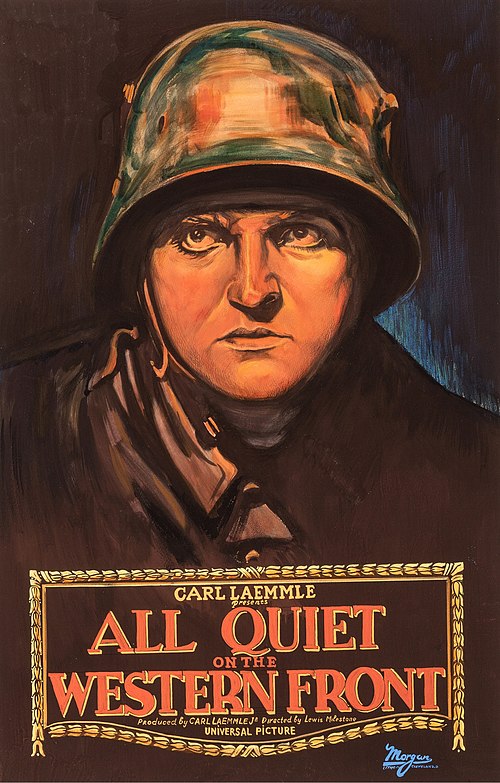
Released in 1930, All Quiet on the Western Front arrived at the dawn of Hollywood’s sound era and redefined how war was portrayed on screen. Far from being a patriotic rallying cry, it exposed the futility, trauma, and devastation of World War I through the eyes of young soldiers who quickly realized they were fighting for something they neither knew nor cared about.
From the commanding presence of Katczinsky, to Himmelstoss’s cruel authoritarianism, and Paul Bäumer’s heartbreaking unraveling, the film weaves a story not just about war, but about innocence lost, comradeship forged in suffering, and the alienation that follows survivors home. Its gritty authenticity—achieved with real veterans, genuine uniforms, and groundbreaking camera work—set a new benchmark for cinema.
Nearly a century later, the themes remain as urgent as ever: the contrast between war’s brutal reality and the lofty ideals of those who never set foot on the battlefield.
In our latest podcast episode, we dig into the making, censorship battles, and enduring relevance of this cinematic milestone. Tune in here:
Selected Sources:
- Kael, Pauline. 5001 Nights at the Movies. Holt, 1991.
- Kelly, Andrew. All Quiet on the Western Front: The Story of a Film. I. B. Tauris, 1988.
- “Western Front.” 1914-1918 Online: International Encyclopedia of the First World War, Freie Universität Berlin, https://encyclopedia.1914-1918-online.net/article/western_front/.
- “Western Front (World War I).” Britannica, 2025, https://www.britannica.com/event/Western-Front-World-War-I.
- “All Quiet on the Western Front.” Encyclopedia.com, 2025, www.encyclopedia.com.
- “All Quiet on the Western Front.” CliffsNotes, www.cliffsnotes.com.
- “All Quiet on the Western Front.” Western Front Association, https://www.westernfrontassociation.com/world-war-i-articles/film-review-all-quiet-on-the-western-front/.
- “How Ullstein Created the Bestseller Par Excellence.” Inside History, Axel Springer, 2022, https://www.axelspringer.com/en/inside/how-ullstein-created-the-bestseller-par-excellence.
- “The Most Loved and Hated Novel About World War I.” Smithsonian Magazine, https://www.smithsonianmag.com/history/most-loved-and-hated-novel-about-world-war-I-180955540/.
- “The First Significant Anti-War Movie.” Smithsonian Magazine: Air & Space, https://airandspace.si.edu/stories/editorial/first-significant-anti-war-movie.
- “All Quiet on the Western Front.” AFI Catalog of Feature Films, The First 100 Years 1893-1993, https://catalog.afi.com/Catalog/moviedetails/2558.
- “All Quiet on the Western Front.” Library of Congress: National Film Preservation Board, https://www.loc.gov/static/programs/national-film-preservation-board/documents/all_quiet.pdf.
- “All Quiet on the Western Front (1930) Review.” Variety, 1930, https://variety.com/1930/film/reviews/all-quiet-on-the-western-front-1200410362/.
- Deutsches Filminstitut & Filmmuseum. “Nothing in the West.” 2009, https://difarchiv.deutsches-filminstitut.de/zengut/dt2tb00154e.htm.
- “All Quiet on the Western Front.” Metacritic: Critic Reviews, https://www.metacritic.com/movie/all-quiet-on-the-western-front/critic-reviews/.
- “All Quiet on the Western Front Published.” The Guardian: From the Archive, 6 Mar. 2019, https://www.theguardian.com/world/from-the-archive-blog/2019/mar/06/all-quiet-on-the-western-front-published-remarque-1929.
- “Was All Quiet on the Western Front (1930) the Most Important War Film Ever Made?” Legion Magazine, https://legionmagazine.com/face-to-face-was-all-quiet-on-the-western-front-1930-the-most-important-war-film-ever-made/.
- “All Quiet on the Western Front.” Institute for the Study of War & Violence Awareness (ISWVA), Dec. 2023, https://www.iswva.org/wp-content/uploads/2023/12/All-Quiet-on-the-Western-Front.pdf.
- “Save That Movie!” The Film Foundation, https://www.film-foundation.org/save-that-movie.
- “Original Film Art: All Quiet on the Western Front (1930).” Original Film Art, https://www.originalfilmart.com/products/all-quiet-on-the-western-front-1930.
 Filmtrospective
Leave a comment